
Turmeric Unveiled: From Sacred Spice to
Global Superfood
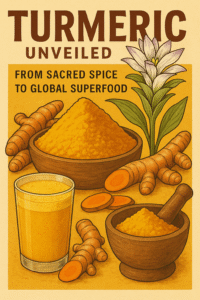 Beyond its common culinary application, turmeric has come to symbolize health, healing, and cultural heritage because of its bright golden color and distinctive earthy aroma. This ancient spice, formally known as Curcuma longa, has been an integral part of human culture for countless generations. Turmeric is still a game-changer when it comes to people’s health and nutrition, having been adored in ancient medicine, studied by modern scientists, and celebrated in the culinary arts.
Turmeric, which has its roots in the Indian subcontinent, holds great cultural and religious significance in South Asia. At least 500 BCE, it was used to cleanse the body, balance the doshas, and treat wounds in Ayurvedic medicine. As a sign of fertility and wealth, turmeric is highly esteemed in Hindu rituals and weddings. The drug eventually made its way into the medicine systems of China, the Arab world, and Africa via the Silk Road, where it was also heavily traded. Because of its long history, it has always been popular and will continue to be useful.
Turmeric, a perennial herb in the ginger family, is mostly cultivated for its underground rhizome. It thrives in tropical climates with abundant precipitation and rich, well-drained soil. Thoroughly growing the plant from seed is the first step in making the rhizome powder; subsequent steps include harvesting, boiling, drying, and grinding. India, Pakistan, Sri Lanka, and Bangladesh are among the top four countries in the world that produce turmeric. Of this, more than 80% comes from India alone.
Turmeric comes in several forms, each suited to a specific use. The most common form of turmeric is ground powder, while other forms such as raw root, oil, capsules, and extracts are also useful. Some varieties, like Alleppey, are prized for their vibrant orange colour and used in cooking; others, like Lakadong, are sought after for their medicinal properties due to their high curcumin concentration. Turmeric is readily available for various uses because of its various forms, which offer versatility in usage and consumption.
Curcumin, turmeric’s main component, has potent anti-inflammatory and antioxidant properties, which contribute to turmeric’s nutritional value. Iron, potassium, manganese, and vitamin C are all present in small but noticeable amounts in just one teaspoon of turmeric. Considering the health benefits as a whole, especially when taking into account the fact that black pepper (piperine) enhances absorption, makes up for the poor nutritional content per serving. Turmeric becomes a potent daily assistance when used with this.
Turmeric is said to provide multiple health benefits. Research has shown that it can improve inflammation, joint health, digestion, and immunological response. Additionally, curcumin’s potential to treat long-term illnesses like cancer, Alzheimer’s, and heart disease is being studied. Consuming turmeric on a regular basis may also help improve mental acuity and disposition. Its functional food and natural remedy status in integrated medicine is due in large part to these qualities.
Many ancient therapeutic systems, like Ayurveda, make comprehensive use of turmeric. Traditional Chinese Medicine uses it as a wound-healing paste, a gastrointestinal regulator, and a detoxifying component in tonics; it also moves qi, or energy, and alleviates pain and blood stagnation. In cases of skin problems and to strengthen the liver, it is prescribed by Unani medicine. All of these uses show how deeply turmeric is believed to have been part of the healing traditions of many different cultures.
Curiosity among scientists over turmeric has recently skyrocketed, fueled by numerous studies that have confirmed its medical properties. Scientists are looking at curcumin’s potential effects on gene expression, inflammation, and oxidative damage. Clinical trials have demonstrated promising results when using turmeric as an adjunctive treatment for a variety of illnesses, including inflammatory bowel disease, depression, and metabolic syndrome. Despite issues with bioavailability, advances in formulation techniques have improved the supplement form of curcumin’s effectiveness.
Turmeric is a world-renowned spice that is loved by cooks all over the globe. Curry powder, dals, and pickles are staples in Indian cuisine. It is used in marinades and spice pastes in Southeast Asian cuisines, but in Middle Eastern rice dishes and stews it is called for. It has made its way into some trendy Western beverages, such as turmeric lattes, health shots, and smoothies. It goes well with ginger, black pepper, cumin, and coriander due to its warm, slightly bitter flavour.
Understanding the properties of turmeric is essential for its effective use. You may make it absorb much better by cooking it with black pepper and fat, such as ghee or coconut oil. You may add it to drinks, roasted veggies, cereals, and soups. To ease a sore throat, mix it with honey. To wind down at night, mix it with warm milk. Turmeric paste, when applied topically, alleviates skin redness, scarring, and acne. Its benefits are adaptable, and its uses are versatile.
Turmeric tablets offer a concentrated form of curcumin; they may be enhanced with piperine or made to be as absorbent as possible. These are quite common among those seeking therapeutic doses for long-term health conditions. However, anyone on blood thinners or experiencing gallbladder issues should only take high doses under expert supervision. It is recommended to always purchase from reputable organizations that employ third-party testing because quality is paramount.
Turmeric is currently a big player in the spice and health industry around the world. Anyone can benefit economically from it, from small-scale farmers to huge export enterprises. Despite rising demand in East Asia, Europe, and North America, India remains the undisputed leader in global trade. Better opportunities have arisen for turmeric farmers as a result of investments in fair-trade and organic turmeric, driven by the need for ethical, clean products.
Sustainability is becoming increasingly crucial as turmeric agriculture expands. Soil quality and producer fairness are both improved by organic agricultural practices, crop rotation, and ethical sourcing. Today, ethical companies are supporting open supply chains and community partnerships. Turmeric that promotes sustainability and well-being is also gaining popularity among conscientious consumers.
Turmeric is amazing because it exemplifies how modern science and old wisdom can coexist. Its trajectory from religious gatherings to academic journals attests to its persuasiveness and relevance. As we continue to seek out natural means of health, turmeric serves as a reminder that many of the most effective remedies have been growing in our own gardens and kitchens for quite some time.
